Remembering Sam Neill
It’s difficult to make sense of a feeling you don’t fully understand, but the real challenge is trying to write these words down when your wuthering eyes won’t let you see beyond an inch. I’ve never been one to express outwardly what I feel, perhaps because, growing up, I never had a safe space where I could speak, share, and be heard. And perhaps that is precisely what’s driving me to write this down today and share it with the world.
The regret.
I guess that, for this to make sense, I have to unlock at least part of my privacy and let you all catch a glimpse of what my life was like growing up. After I was born, my parents were working and couldn’t take care of me, so they left me with my grandparents and godmother in another town until I was two years old. I don’t remember much of that time, obviously, but I do remember not wanting to go back to my parents’.
After I moved back in with them, I started going to daycare. And although I was still very young, I remember the experiences I had there. I remember how one of the daycare workers would lock me in the bathroom for hours until it was time for someone to pick me up, just so I wouldn’t “disturb.” I remember how, whenever other kids pushed me, kicked me, or bit me, I was the one who got blamed if I dared to defend myself. I remember being left out of birthday celebrations so I wouldn’t spoil the mood. And I remember one birthday in particular, when I was locked in a dark bathroom with a large doll wearing a blue jacquard shirt until the party was over.
But what I remember the most is how I felt: lost, not knowing who to tell or who would help me, because I knew that if I spoke, I would either be dismissed or ignored.
Today is the first time I’m talking about this.
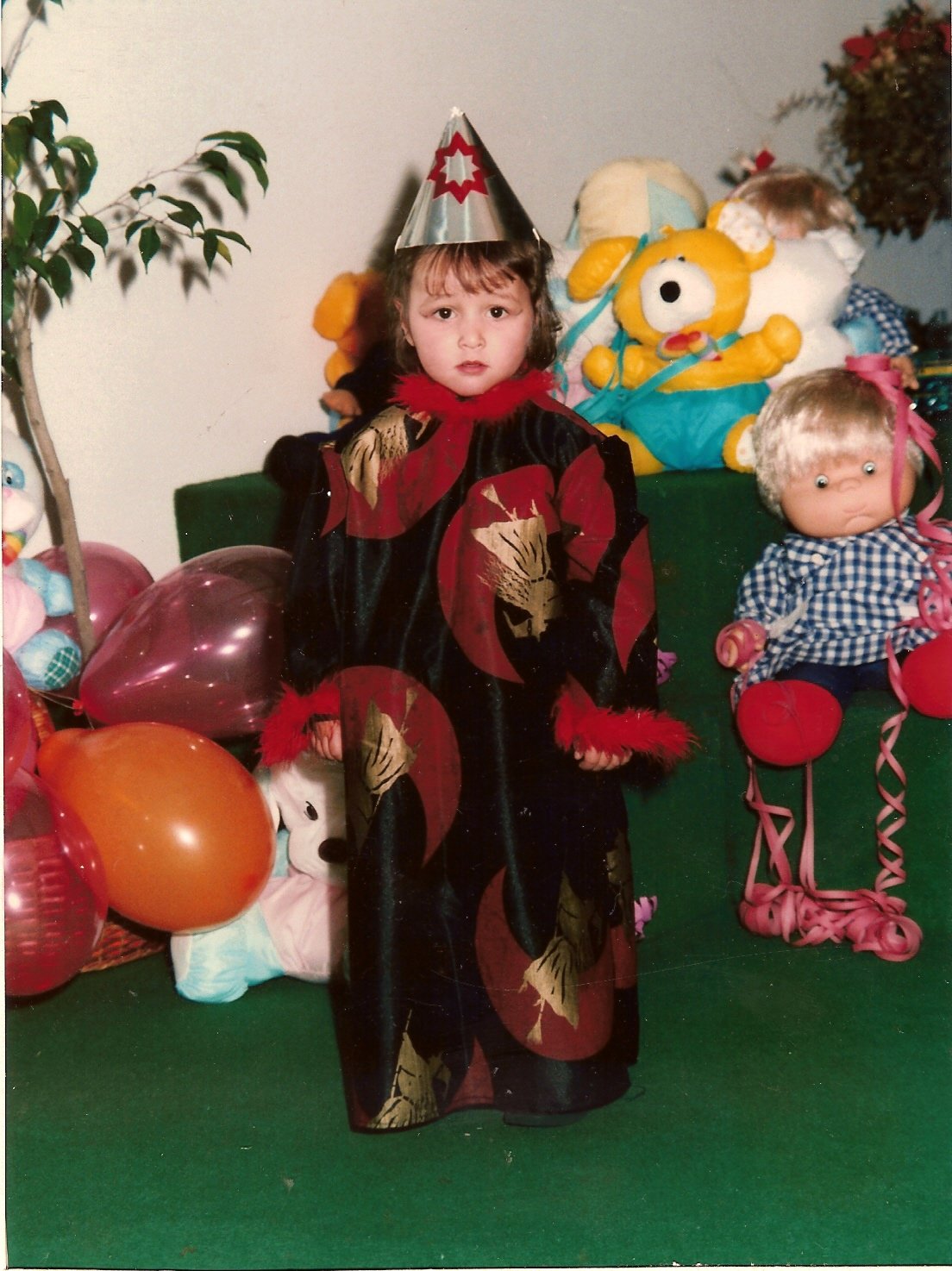
Me during Carnival at daycare.
Jurassic Park was released back in 1993, and it was the first film I ever saw in a cinema. I went to see it with my older cousin and my godfather. I didn’t take much in back then—I was still a small kid—but what left the deepest impression on me was Sam Neill’s character, Dr. Alan Grant, and the lengths he went to protect those kids.
I remember wondering why I couldn’t have someone like that in my own life. That day, I learned that I could—and had to—be that person myself. I had to become the one who would help me push through everything. And I did: through kindergarten, where I was constantly rejected and excluded from group activities; through school, where I was cast aside during celebrations and performances because my height didn’t harmonize with the rest of the kids’; and through high school, where I was bullied for being, first, too tall, then too fat, and too ugly.
But that’s enough about me. This is about remembering a person who, unknowingly, played such a significant role in my life. How the presence of a protective adult in a film influenced me in more ways than I could have imagined: encouraging me in a way no one else ever had, and growing into an unconditional love for watching films, then for acting, and finally for writing them.
He never truly left my mind, and some time ago, I unexpectedly came across an interview with him that resonated with me on so many levels. He spoke openly about depression and imposter syndrome, about how working in what you love—acting, writing, singing, creating—keeps the darkness at bay. I felt connected to him in a way I never had before. It resonated so deeply that it almost felt unreal, because why would someone so talented and accomplished feel the same way I did? I’m no one.
And because I’m no one, I never dared to write to him and tell him how profoundly he had influenced my life, or how dear he had become to me, even if I couldn’t fully explain why. I never sent that message because I was convinced he would never reply, because why would he?
But today I understand that maybe I should have let him know. And even if he had never answered, perhaps simply knowing how much he had done for me, without ever realizing it, would have made him happy.
Sometimes we have to stop trying to rationalize everything we feel and simply allow ourselves to feel it, even when it doesn’t make sense, even when we don’t know where those feelings come from. Only then can we decide whether to embrace them or let them go. Had I understood that sooner, I wouldn’t be sitting here now with the regret of never letting Sam Neill know how much he meant to me. Maybe I should have told him.
That’s why I’m writing this today: as a tribute to him, to simply say thank you, and, selfishly, for myself—to help me carry this grief, because bearing the pain of loss alone is simply too heavy. I hope that, by finally letting these words out, I can soften the pain and begin to close the hollow I feel in my chest. I also can’t help but think that, if he had ever known me, he would have been disappointed by my decision to give up writing. So perhaps the very least I owe him is to reconsider that decision.
Today, I’m that little kid again, mourning the loss of a symbolic father figure. I’m once again that child who found a model of safety in a fictional character, then later found comfort in the humanity of the actor behind that character.
Rest in peace, Sam.
You may never have known the difference you made, but it will never be forgotten.